Avoiding common trademark registration mistakes is essential for protecting your brand and securing your intellectual property rights.
A trademark is a valuable asset for any business. It distinguishes your products and services from those of your competitors. Moreover, it helps build brand recognition and consumer trust.
However, trademark registration requires careful preparation and planning. Even a single mistake can lead to registration refusals, additional costs, or inadequate brand protection.
In this article, we explore six common trademark registration mistakes and explain how to avoid them.
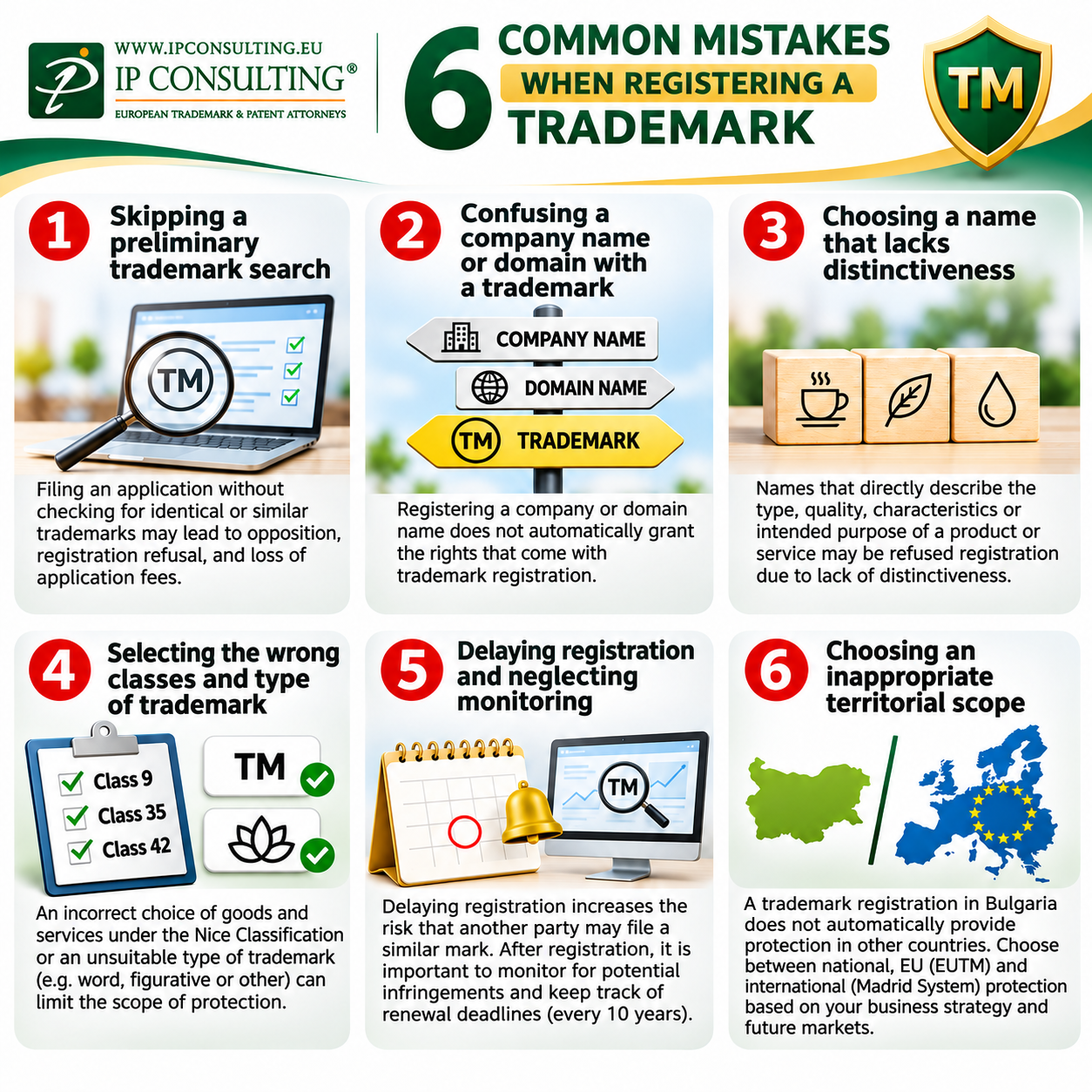
1. Failure to Conduct a Preliminary Trademark Search
One of the most common mistakes is filing a trademark application without checking for existing identical or similar trademarks.
If another party holds earlier rights in a similar trademark for identical or similar goods and services, they may oppose your application. As a result, you could face a registration refusal and lose the application fees.
Therefore, it is advisable to conduct a professional trademark search before filing. This helps you identify potential risks, avoid unnecessary expenses, and make informed business decisions.
2. Confusing Company Names and Domain Names with Trademarks
Many business owners believe that registering a company name or purchasing a domain name is enough to protect their brand.
In reality, company names, domain names, and trademarks serve different purposes. They also provide different legal rights.
Registering a company or domain name does not automatically grant the rights associated with trademark registration.
For this reason, consider trademark registration a separate and essential step in protecting your business.
3. Choosing a Name That Lacks Distinctiveness
To qualify for registration, a trademark must have distinctive character. In other words, it must help consumers distinguish your goods and services from those of other businesses.
Trademark offices may refuse names that directly describe a product’s type, quality, characteristics, or intended purpose.
Similarly, generic or commonly used terms may not qualify for registration.
Therefore, when developing a new brand, choose an original and distinctive name. This can improve your chances of obtaining registration and effective legal protection.
4. Choosing the Wrong Trademark Classes and Type of Mark
When filing a trademark application, you must specify the goods and services you want to protect. The Nice Classification organizes these into 45 classes.
However, choosing the wrong goods and services can leave important business activities outside the scope of protection. An overly narrow selection can also limit your future business development.
In addition, you need to choose the appropriate type of trademark. Common types include:
- Word marks: Protect verbal elements independently of a specific graphic presentation.
- Figurative marks: Protect signs in their filed visual form.
- Other types of trademarks: Include three-dimensional, sound, and color marks.
Depending on your brand, registering its name and logo separately may provide more comprehensive protection.
5. Delaying Registration and Neglecting Trademark Monitoring
Businesses often postpone trademark registration until their products or services become popular.
However, delaying registration can create unnecessary risks. In the meantime, another party may apply to register an identical or similar trademark.
Furthermore, trademark protection does not end with registration. Ongoing monitoring is essential for managing and protecting your rights.
Important steps include:
- Monitoring new applications for identical or similar trademarks.
- Identifying potential infringements in the marketplace.
- Taking timely action to enforce trademark rights.
- Keeping track of renewal deadlines.
Remember that trademark registrations in Bulgaria and the European Union are valid for 10 years. You can renew them indefinitely for successive 10-year periods.
6. Choosing an Inappropriate Territorial Scope of Protection
Trademark protection is territorial. This means that registering a trademark in one country does not automatically protect it in other countries.
Depending on your current and future markets, you can choose from several registration options:
- National trademark: Provides protection within the relevant country.
- European Union trademark (EUTM): Provides uniform protection across all 27 EU member states.
- International trademark registration under the Madrid System: Allows you to seek protection in selected countries and participating organizations.
- Therefore, consider your business strategy, international expansion plans, and available budget when choosing the territorial scope of protection.
How to Avoid Common Trademark Registration Mistakes
Avoiding trademark registration mistakes requires careful planning and a comprehensive protection strategy.
First, conduct a preliminary trademark search and choose a distinctive mark. Next, identify the relevant goods and services and determine the appropriate territorial scope of protection.
Finally, establish an ongoing trademark monitoring strategy. Regular monitoring helps you identify potential threats and take timely action to protect your rights.
The IP Consulting team provides professional assistance with trademark searches, registration, monitoring, renewal, and enforcement across the European Union and worldwide.
Contact us to discuss the most appropriate trademark protection strategy for your business.
Email: office@ipconsulting.eu